
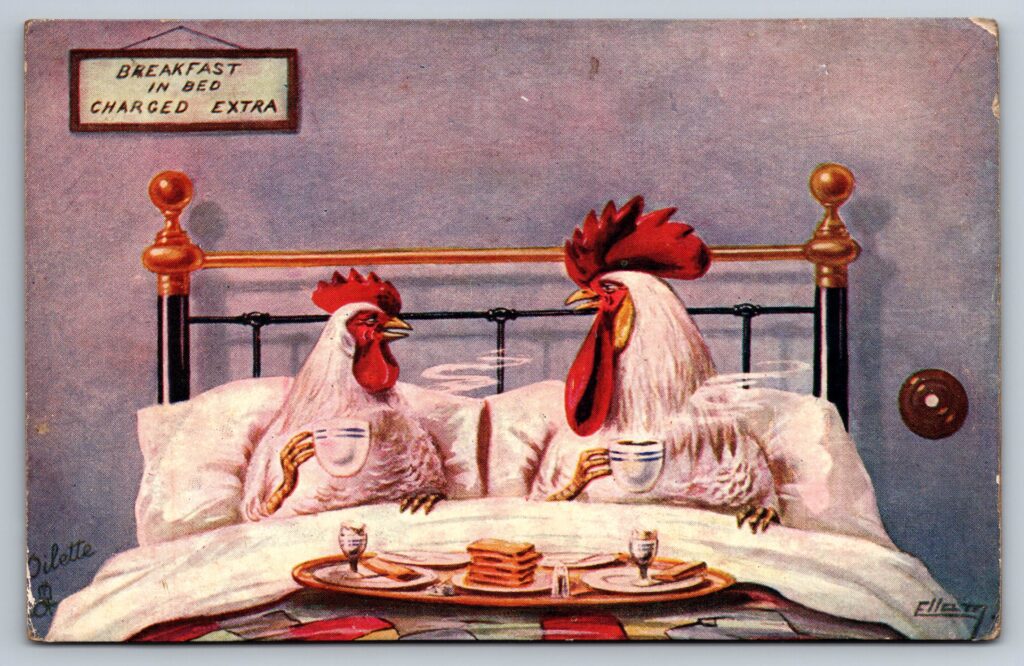
This Raphael Tuck & Sons postcard features a rooster and hen behaving like people as they enjoy breakfast in bed. the card is part of Tuck’s Breakfast in Bed, Series I, a humorous six-card series illustrated by British artist William Henry Ellam.
The scene is wonderfully Edwardian, with the two chickens sitting up in a large brass bed, enjoying their morning tea while a breakfast tray is brought to them.
And, as the little sign above the bed warns:
“BREAKFAST IN BED CHARGED EXTRA”
It is a wonderfully simple joke, but one that still works more than a century later.
This post may contain affiliate links. Read our Affiliate Disclosure.
RapRaphael Tuck & Sons’ Breakfast in Bed Series
The postcard is number 9321 and belongs to Breakfast in Bed, Series I, a humorous Oilette series published by Raphael Tuck & Sons.
TuckDB records Series I as a set of six postcards, featuring different pairs of animals:
- Cats
- Chickens
- Donkeys
- Frogs
- Geese
- Spaniels
The cards were printed in England and were sold in Great Britain, France, Canada, the United States and Italy. TuckDB records the first use of the series as 19 August 1907.
The series was listed in Tuck’s 1908/1909, 1911/1912 and 1913/1914 Postcard Catalogues. The cards could also be produced with different greetings and captions, meaning that collectors may find variations of the same animal design.
Illustrated by William Henry Ellam
The Ellam signature can be seen in the lower right-hand corner of the postcard.
The artist was William Henry Ellam (1858–1935), a British artist whose work included humorous postcard illustrations.
Ellam illustrated a number of postcards featuring animals behaving like people, and his work is particularly appealing to collectors who enjoy humorous and anthropomorphic postcards.
The Breakfast in Bed series is a lovely example of this style. The animals aren’t simply being shown as animals; they have been given recognisable human personalities and placed into an amusing domestic situation.
Different Versions of the Postcards
One interesting feature of Tuck’s postcard production was that the same basic illustration could appear with different captions or greetings.
The Breakfast in Bed chicken design is recorded with variations including “A Happy Christmas to You”, “A Happy New Year” and “A Happy Christmas”.
There were also versions connected with holidays and British resorts, including Weymouth, Poole and Cowes, as well as humorous “rest cure” captions.
This means that collectors can sometimes find several different versions of what initially appears to be the same postcard design.
The Message on the Back
This particular example was not completely unused.
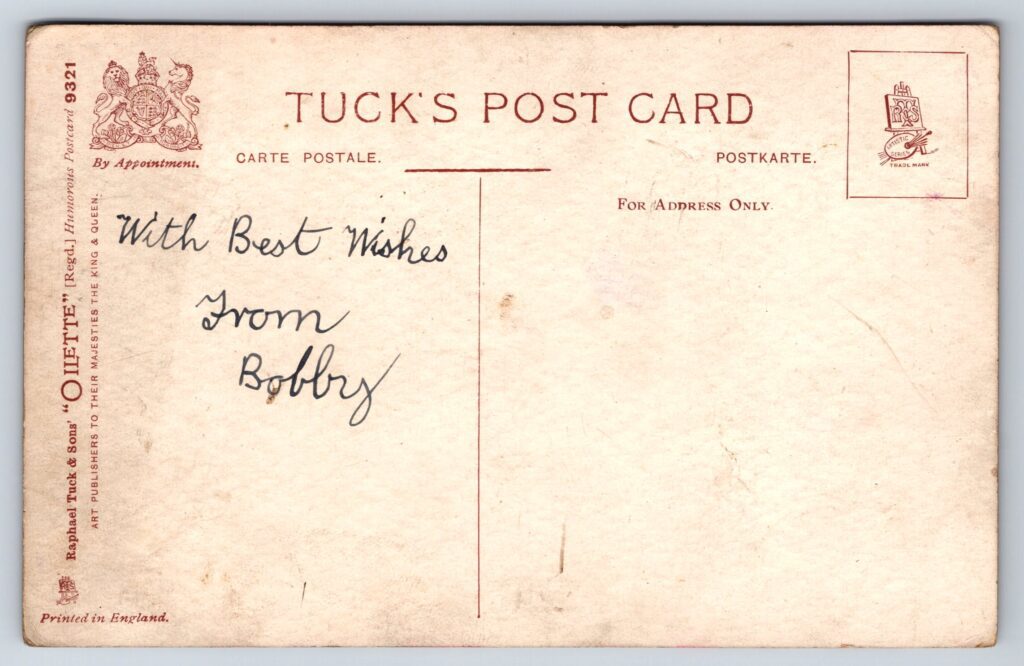
Written on the reverse is the short message:
“With Best Wishes from Bobby”
There is no postal address or cancellation on the card, so it appears to have been retained rather than sent through the postal system.
Although the message is brief, it adds a little piece of personal history to the postcard. We don’t know who Bobby was or who the card was intended for, but the handwriting has survived for well over a century alongside the original illustration.
The back also carries the familiar “Tuck’s Post Card” wording, the Tuck crest and the Art Series trade mark, together with “Printed in England.”
Why Collectors Like These Old Animal Postcards
Anthropomorphic postcards, animals dressed or behaving like humans, remain popular with collectors because they combine historical interest with humour.
The Breakfast in Bed series is particularly appealing because the concept is so easy to understand even today. The animals are placed into a recognisably human situation, and each design has its own little visual joke.
The cards are also attractive examples of early Tuck Oilette postcards, making them interesting from both an artistic and publishing-history point of view.
For collectors of Raphael Tuck postcards, William Henry Ellam, humorous postcards or anthropomorphic animals, a card from this series makes an enjoyable addition to a collection.
A complete set of the six designs is even more difficult to assemble than finding one individual card.
How Old Is This Tuck Postcard?
TuckDB records the first use of Breakfast in Bed, Series I as 19 August 1907.
That makes this postcard around 119 years old in 2026.
It is a lovely survivor from the Edwardian period, when picture postcards had become an enormously popular way of sending short messages to friends and family.
The postcard also gives us a glimpse of the humour of the period. A simple scene of a couple enjoying breakfast in bed could be turned into a playful cartoon, with the animals adding an extra layer to the joke.
Value of the 1907 Tuck Breakfast in Bed Postcard
TuckDB gives the cards in the Breakfast in Bed, Series I an estimated value of $20, although this should be regarded as a guide rather than a guaranteed selling price.
Actual prices for vintage postcards can vary considerably according to condition, rarity, whether the card has been posted, the particular variation, and demand from collectors.
For comparison, a 1907 Ellam Breakfast in Bed frog card from the same Tuck series was listed at £5 in a UK postcard dealer’s sales list in 2022, in very good condition.
This particular chicken card has attractive, strong colours but does show some age-related wear, including rounded corners, edge wear and discolouration. It also has the handwritten message on the reverse.
Taking those factors into account, I would estimate the value of this individual postcard at approximately:
£5–£10
A particularly clean example, an unusual caption or a scarce variation could be worth more, while a complete set of all six Breakfast in Bed, Series I cards would naturally be of greater interest to a collector.
For me, though, the real appeal of this postcard is the wonderfully silly image of a rooster and hen enjoying breakfast in bed, with the stern reminder that, even in 1907, breakfast in bed wasn’t free!
Looking to add to your collection?
Browse the latest vintage postcards we have for sale.