
Vintage holiday postcards can preserve much more than a picture of a place. They can capture a particular moment in its history, sometimes showing buildings and landscapes that have since disappeared completely.
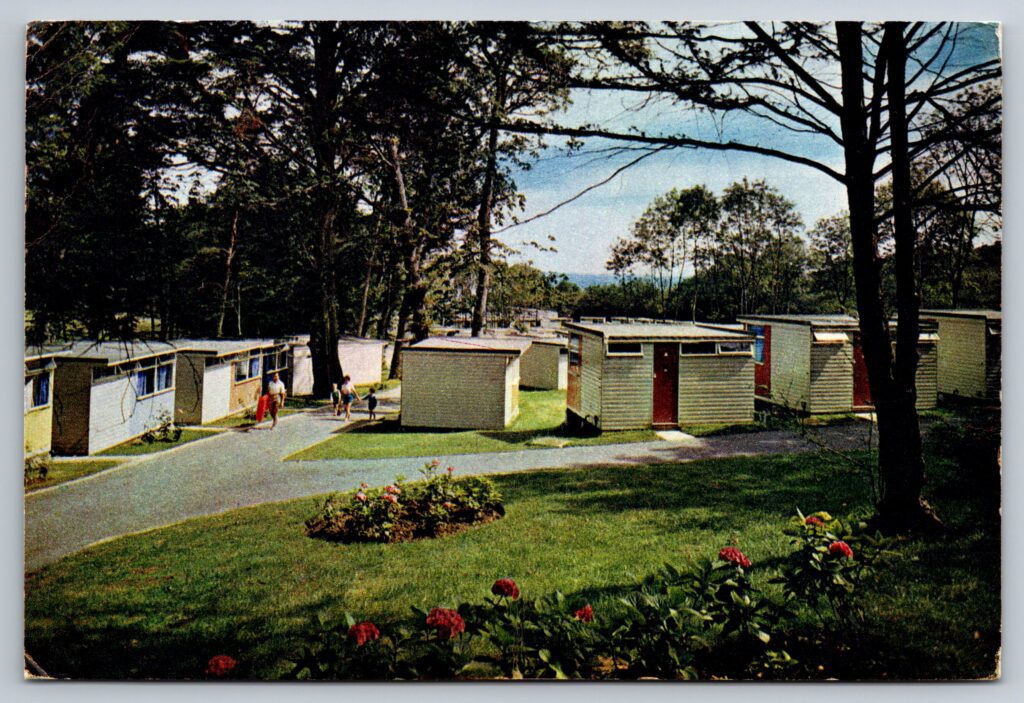
This vintage postcard from the Postcard Attic collection shows Warner’s Woodside Bay Holiday Village on the Isle of Wight, with rows of holiday chalets set amongst trees overlooking the Solent.
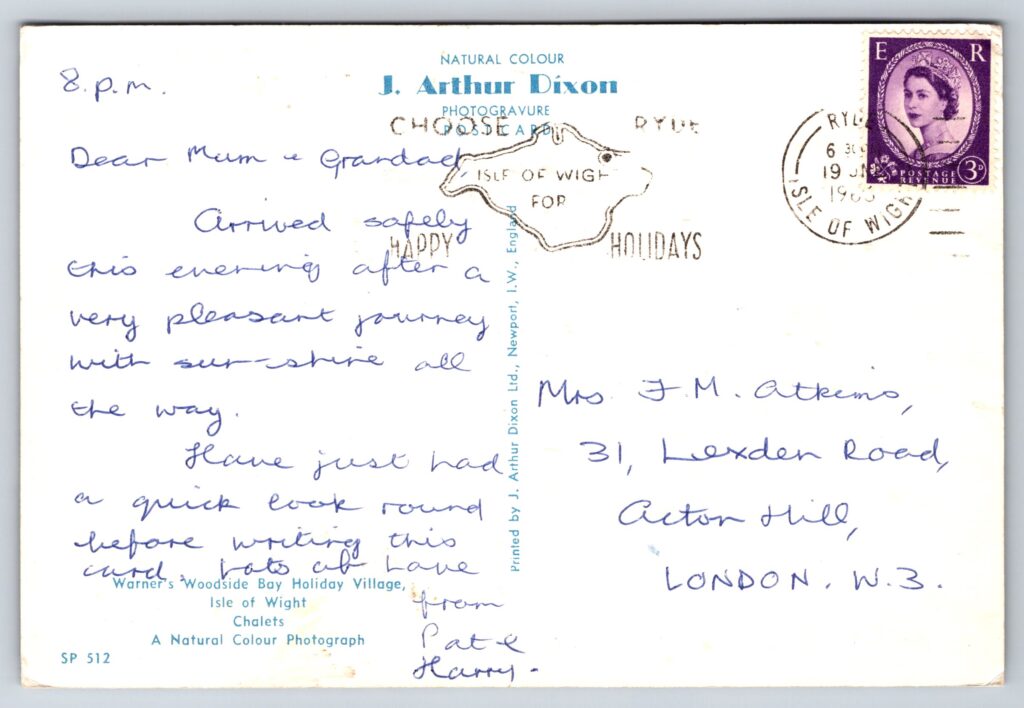
The postcard was produced by J. Arthur Dixon and is numbered SP 512. The reverse describes the scene as “Warner’s Woodside Bay Holiday Village, Isle of Wight Chalets” and identifies it as a Natural Colour Photograph.
The card was also posted, giving it an additional little piece of history. The message tells the recipients that the sender had arrived safely at Woodside Bay after a pleasant journey in sunshine, a small glimpse of an ordinary family holiday more than half a century ago.
This post may contain affiliate links. Read our Affiliate Disclosure.
The story of Woodside Bay
The history of the site goes back much further than the Warner holiday camp.
Woodside House, overlooking Woodside Bay on the north-eastern coast of the Isle of Wight, dated from the nineteenth century. The property stood in a large area of woodland overlooking the Solent and had its own beach. Local historical sources record that the site had been used as a naturist camp from the 1930s, before closing during the Second World War and subsequently reopening.
The site was eventually acquired by Warner’s Holiday Camps as the company expanded its presence on the Isle of Wight.
Plans were made for a new holiday camp, and construction began in the early 1960s. The original proposal was for accommodation for around 650 holidaymakers, with single, double and family chalets, many of which had private bathrooms, a relatively attractive feature for a 1960s holiday camp.
The postcard therefore dates from the era when Woodside Bay was operating as a Warner holiday destination.
A holiday camp overlooking the Solent
Woodside Bay was set in approximately 30 acres of woodland and occupied an unusually attractive position overlooking the Solent.
The camp included holiday chalets as well as a range of facilities designed to keep holidaymakers entertained without having to leave the site. These included swimming pools, a ballroom, bars, dining facilities and sporting activities.
An outdoor swimming pool overlooked the Solent, while the main complex included an indoor pool and entertainment facilities.
The location also meant that holidaymakers could enjoy views across the water towards the mainland. According to the history of the site published by its later operators, the large windows of the main complex provided views across the Solent, and passing ships could be seen from the camp.
That makes the postcard rather more evocative than an ordinary picture of holiday accommodation. It shows the chalets within their wooded surroundings — the kind of setting that was part of the attraction of the resort.
Woodside Bay grows
The holiday camp was subsequently expanded.
Warner’s acquired the adjoining Underwood site, adding further woodland and land to the holiday village. A footbridge was constructed to connect the two areas, and the capacity of the enlarged camp eventually rose to around 900–950 holidaymakers, depending on the source. One historical account gives a capacity of 950 with approximately 250 staff.
For a relatively small holiday company, Woodside Bay was therefore a substantial operation.
Warner’s itself had grown considerably since Captain Harry Warner established his first holiday camp at Hayling Island in the early 1930s. By the 1960s and 1970s, the company operated a sizeable network of holiday camps around Britain, including several on the Isle of Wight.
What happened to Woodside Bay?
Unfortunately, Woodside Bay’s life as a Warner holiday camp was relatively short.
The camp was closed in the early 1980s. Sources differ slightly over the precise sequence of ownership and closure, but the general history is clear: Warner’s sold its interest in the site around the early 1980s, the camp subsequently closed, and the abandoned buildings deteriorated.
The site then became something of a time capsule.
Rather remarkably, many of the buildings remained standing for years after the holidaymakers had gone. By the early 2000s, photographs showed the former camp heavily overgrown and badly vandalised. Fires had also destroyed several buildings, including the main entertainment building.
It is quite a contrast with the cheerful holiday scene shown on this postcard.
Where the postcard shows tidy chalets, landscaped grounds and holidaymakers enjoying their summer break, later photographs show an abandoned resort slowly being reclaimed by vegetation.
From abandoned holiday camp to modern holiday park
The story did not end there.
After years of dereliction, plans were eventually made to redevelop the site. Isle of Wight Council planning records show proposals for the redevelopment of Woodside Bay Holiday Village, including new holiday lodges and associated leisure facilities.
The site was subsequently redeveloped and became part of the modern holiday accommodation complex now associated with Woodside Bay Lodge Retreat/Woodside Coastal Retreat. The modern development is a very different holiday experience from the Warner camp pictured on this postcard, but the wooded setting beside the Solent remains an important part of its character.
A postcard of a lost Isle of Wight holiday
What I particularly like about this postcard is the glimpse it gives us into an ordinary holiday of the past.
There are no famous landmarks or dramatic tourist attractions here. Instead, we see rows of modest chalets, trees, lawns and the kind of quiet holiday setting that would have been familiar to thousands of British families in the 1960s and 1970s.
The handwritten message on the reverse makes it even more personal. Someone actually stayed at Woodside Bay, enjoyed the journey in the sunshine and took the time to send a postcard home.
Decades later, the holiday village itself disappeared, leaving the postcard as a small record of what the resort looked like when it was still welcoming holidaymakers.
How much is a Warner’s Woodside Bay postcard worth?
Woodside Bay postcards are an interesting niche for collectors of Isle of Wight postcards, Warner’s Holiday Camps, British holiday camps and social history ephemera.
Current asking prices provide some useful context. Recent eBay listings for J. Arthur Dixon Woodside Bay chalet postcards have been around £5 to £7.50, although asking prices are not the same as confirmed selling prices.
For a typical example in good condition, I would therefore suggest a rough value range of £3–£8, with a particularly desirable view, unusual postcard, excellent condition or interesting postal history potentially attracting more from a specialist collector.
This particular example has added interest because it is postally used, with a handwritten message and Isle of Wight postmark. The fact that it records a now-vanished Warner holiday village also gives it appeal beyond simply being a vintage holiday postcard.
For collectors, it is a lovely little snapshot of Woodside Bay as it was when summer holidays meant a chalet, a swimming pool, the seaside and a postcard home.
Looking to add to your collection?
Browse the latest vintage postcards we have for sale.