
Victorian and Edwardian postcards often carried messages that went beyond the printed greeting. Flowers were not chosen purely for decoration. Many were selected for their symbolic meanings, allowing senders to express emotions, wishes, and sentiments through a visual language known as floriography, or the language of flowers.
For collectors today, understanding these floral symbols can provide fascinating insights into the messages that postcard publishers and senders may have intended to convey.
This post may contain affiliate links. Read our Affiliate Disclosure.
What Is Floriography?
Floriography is the practice of assigning meanings to flowers. While flower symbolism has existed for centuries, it became especially popular during the 19th century following the publication of numerous flower dictionaries in Britain, Europe, and North America.
During the Victorian era, social conventions often encouraged restraint in expressing emotions directly. Flowers provided a subtle way to communicate feelings ranging from love and admiration to sympathy and friendship.
As postcards became one of the most popular forms of communication in the late Victorian and Edwardian periods, floral imagery naturally became a common feature of postcard design.
A Note About Flower Meanings
One important point to remember is that flower meanings were never completely standardised. Different Victorian flower dictionaries sometimes assigned different meanings to the same flower. Publishers also used flowers for their beauty as well as their symbolism.
The meanings below represent those most commonly associated with flowers during the late Victorian and Edwardian periods, but alternative interpretations can sometimes be found.
Why Flowers Were So Popular on Postcards
Floral postcards appealed to both publishers and buyers. Flowers were attractive, instantly recognisable, and rich in symbolism. They could be used on birthday cards, greetings from holiday resorts, Valentine’s cards, friendship cards, Easter cards, and sympathy cards.
A carefully chosen flower might reinforce a written sentiment or, in some cases, carry the message entirely on its own.
Rose Meanings on Vintage Postcards
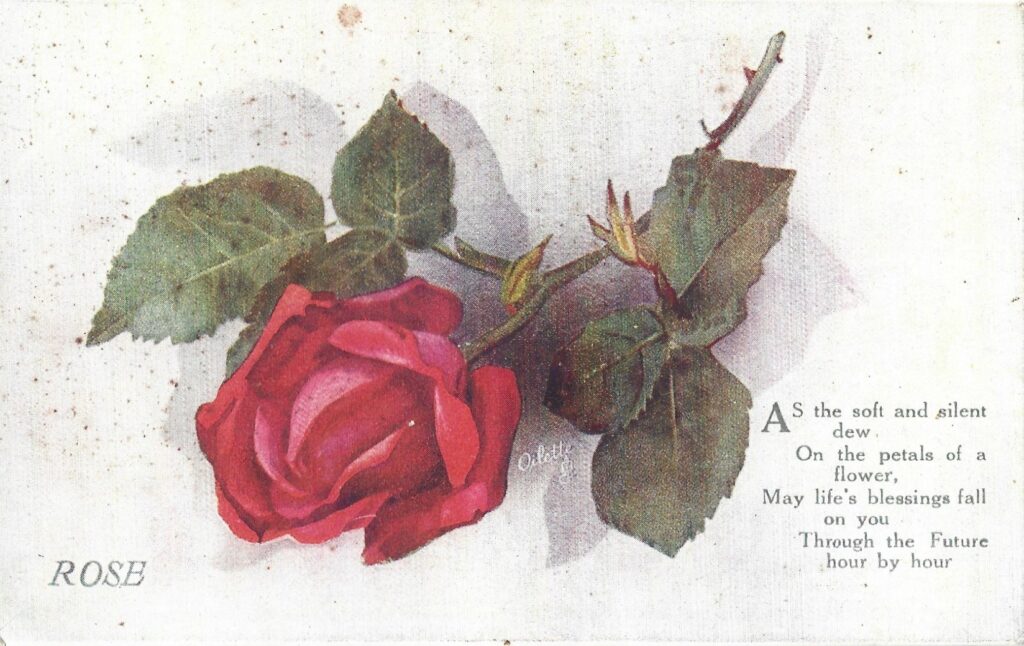
Red Rose
Meaning: Love, passion, deep affection
The red rose remains one of the strongest symbols of romantic love. It appeared frequently on Valentine’s postcards and romantic greetings, often accompanied by hearts, cupids, or love verses.
White Rose
Meaning: Purity, innocence, secrecy, worthy love
White roses were often associated with virtue and sincerity. They commonly appeared on wedding-related postcards and cards celebrating important milestones.
Pink Rose
Meaning: Admiration, affection, grace
Pink roses generally symbolised gentler feelings than red roses. They expressed appreciation, admiration, and happiness.
Yellow Rose
Victorian Meaning: Jealousy, infidelity, waning affection
This is one of the most misunderstood flower meanings today. Modern flower symbolism often associates yellow roses with friendship and happiness, but many Victorian flower dictionaries linked them with jealousy or a decline in romantic feelings. For collectors of Victorian postcards, the historical meaning is usually the more relevant interpretation.
Forget-Me-Not
Meaning: Remembrance, faithful love, enduring memories
The forget-me-not became one of the most popular flowers on postcards. Its symbolism was immediately recognised by many people and made it a natural choice for friendship cards, farewell messages, and greetings sent across long distances.
Today it remains one of the most commonly encountered flowers on vintage postcards.
Pansy
Meaning: Thoughts, remembrance, “thinking of you”
The name derives from the French word pensée, meaning “thought”. When a pansy appeared on a postcard, it often carried the simple message that the sender was thinking about the recipient.
Pansies were especially popular on sentimental greetings and friendship cards.
Violet
Meaning: Faithfulness, modesty, devotion
Violets symbolised loyalty and steadfast affection. They frequently appeared in romantic and friendship-themed postcards and were often associated with sincerity and humility.
Daisy
Meaning: Innocence, purity, loyal affection
Daisies were valued for their simple appearance and wholesome symbolism. They commonly featured on postcards intended for children, young women, or springtime greetings.
Lily of the Valley
Meaning: Return of happiness, sweetness, humility
Lily of the valley was a favourite flower in Victorian symbolism. Its delicate white flowers made it particularly suitable for postcards celebrating spring, recovery, and new beginnings.
White Lily
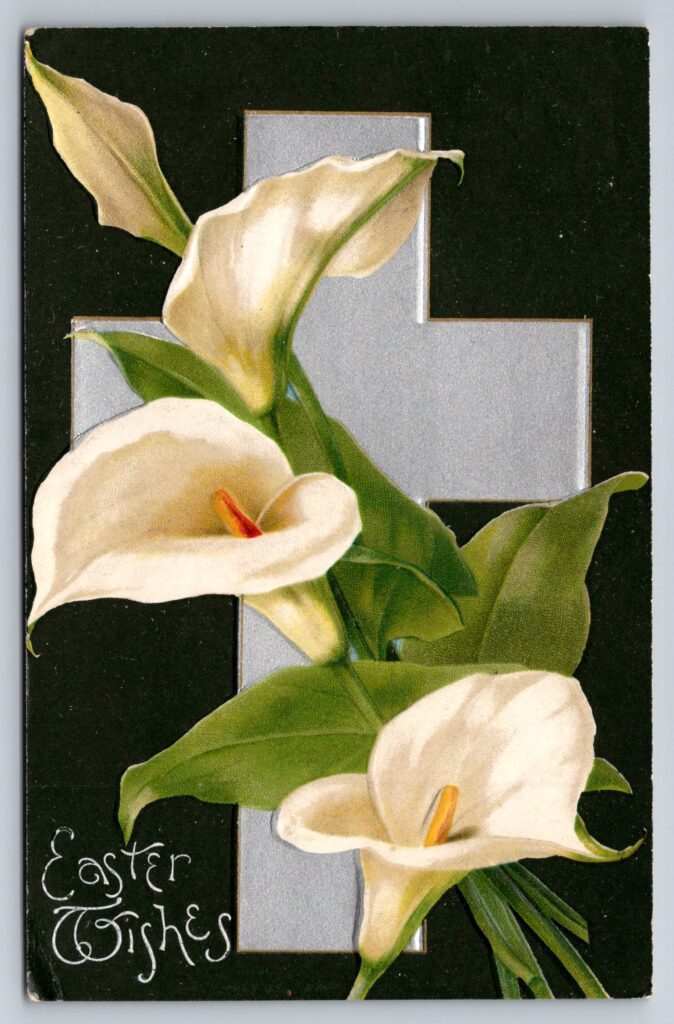
Meaning: Purity, virtue, innocence
White lilies carried strong religious and moral associations. They frequently appeared on Easter cards, religious greetings, and postcards related to weddings and important ceremonies.
Carnations
Carnation meanings varied significantly depending on colour.
Red Carnation
Meaning: Love, admiration, affection
Pink Carnation
Meaning: Gratitude, affection, remembrance
White Carnation
Meaning: Pure love, innocence, good fortune
Yellow Carnation
Meaning: Rejection, disappointment, disdain
Because colour was so important in floriography, identifying the shade used on a postcard can help determine the intended sentiment.
Iris
Meaning: Hope, faith, wisdom
The iris was associated with positive qualities including faith and courage. Its striking appearance also made it a popular decorative subject for Art Nouveau and early twentieth-century postcard designs.
Sunflower
Meaning: Adoration, constancy, loyalty
Sunflowers generally represented steadfast devotion and admiration. Their tendency to turn towards the sun made them a natural symbol of faithfulness and constancy.
Hyacinth
The meaning of hyacinths depended heavily upon their colour.
- Blue hyacinth: Constancy and sincerity
- Purple hyacinth: Sorrow or seeking forgiveness
- White hyacinth: Loveliness and prayers
- Red hyacinth: Playfulness or sport
As a result, hyacinths can be more difficult to interpret on postcards unless the colours are clearly visible.
Poppy
Meaning: Sleep, consolation, remembrance
Poppies were associated with rest and memory long before they became widely connected with military remembrance after the First World War.
On Victorian postcards, they often symbolised consolation, peaceful sleep, or affectionate remembrance rather than the specific wartime associations familiar today.
The Importance of Colour
In floriography, colour could completely alter a flower’s message.
For example:
- Red rose = romantic love
- White rose = purity
- Yellow rose = jealousy or fading affection
- Pink rose = admiration
The same principle applied to carnations, hyacinths, and several other flowers. When interpreting a vintage postcard, both the flower and its colour should be considered together.
Reading Floral Postcards Today
Not every floral postcard was designed according to strict floriographic rules. Some publishers simply chose flowers because they were beautiful or fashionable. However, many cards were created at a time when flower symbolism was widely understood and appreciated.
Learning the language of flowers can therefore add another layer of meaning to a postcard collection and help modern collectors better understand the social customs of the Victorian and Edwardian periods.
Final Thoughts
The popularity of floral postcards reflects a time when flowers were more than decorative motifs. A red rose could declare love, a violet could promise faithfulness, a pansy could say “I’m thinking of you”, and a forget-me-not could preserve a cherished memory.
Whether used deliberately or simply appreciated for their beauty, these floral designs remain one of the most fascinating aspects of vintage postcards. Understanding their symbolism allows us to see the cards not just as pieces of printed ephemera, but as messages conveyed through the language of flowers.
Learn More About the Language of Flowers
For readers interested in exploring flower symbolism in greater depth, Floriography: An Illustrated Guide to the Victorian Language of Flowers by Jessica Roux is a useful modern reference. The book examines the history of floriography and explains the meanings traditionally associated with a wide range of flowers, making it a helpful companion for postcard collectors researching floral designs.
Looking to add to your collection?
Browse the latest vintage postcards we have for sale.