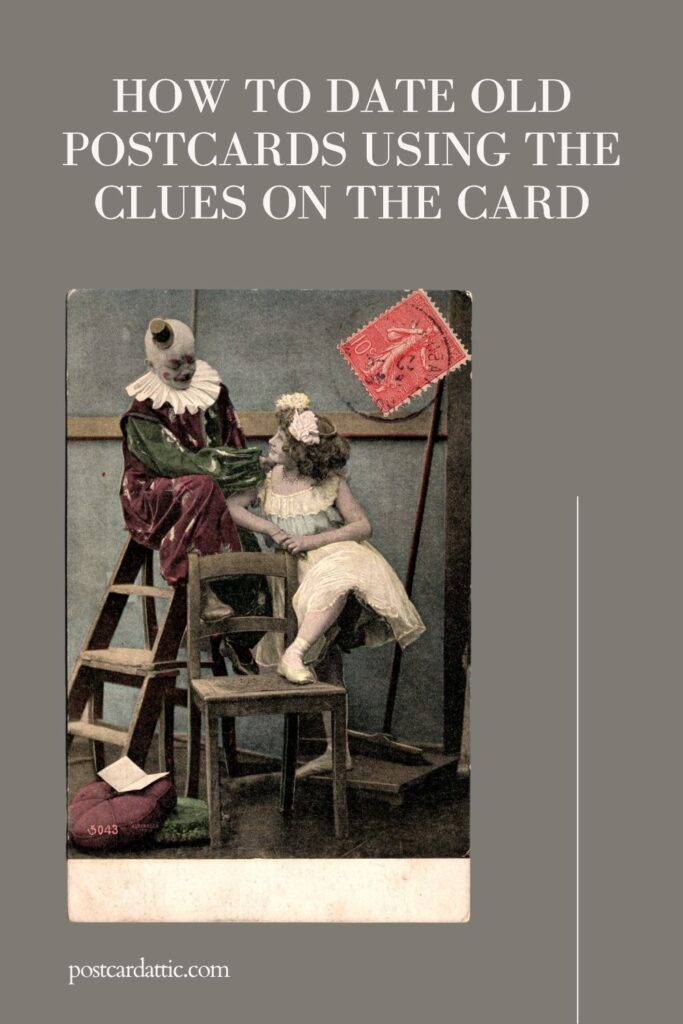
Dating an old postcard isn’t always as simple as checking the postmark. Some postcards were never posted, while others may have been kept for several years before they were sent.
Fortunately, old postcards contain plenty of other clues. The back design, publisher, series number, stamp, postal wording and even details within the picture can all help narrow down when a postcard was produced.
One particularly useful clue is whether the postcard has a divided or undivided back. However, there is an important difference between British and American postcards that can easily lead to cards being incorrectly dated.
Here’s what I look for when researching postcards for Postcard Attic.
Start With the Postmark
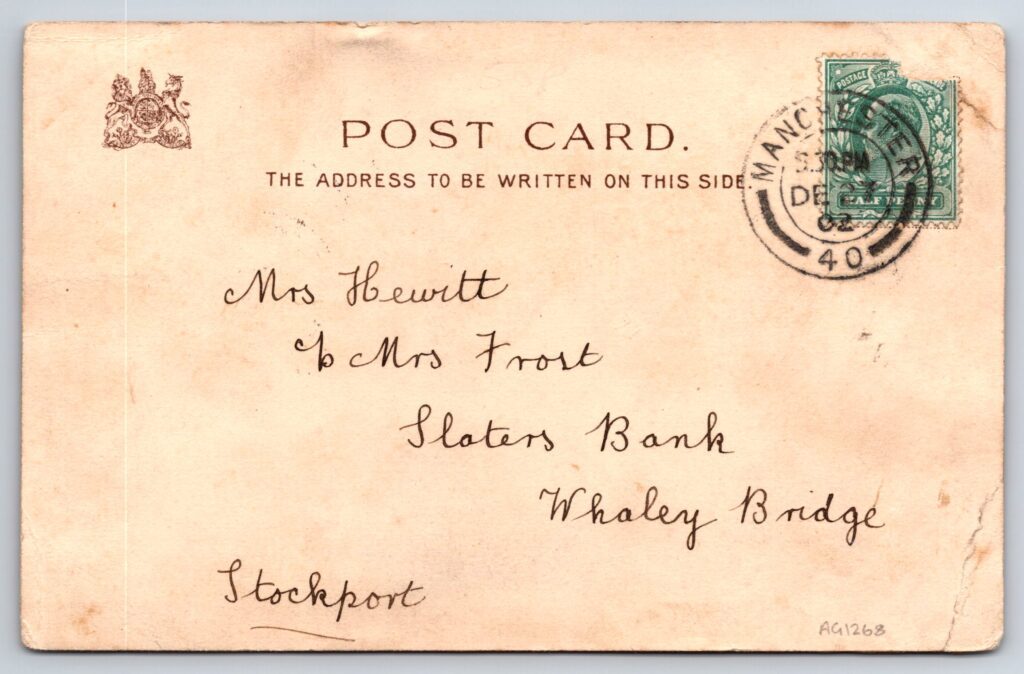
If a postcard has been through the post, the postmark is the obvious place to start.
A clearly dated postmark proves that the postcard existed by that date. It doesn’t necessarily tell you when the card was originally published.
For example, a postcard postmarked in 1910 may have been printed that year, but it could equally have been produced several years earlier and remained unsold or unused.
If the postmark is difficult to read, a high-resolution scan or photograph can sometimes reveal a faint year or month that isn’t obvious to the naked eye.
Also look for a handwritten date in the message. If this agrees with the postmark, it can help confirm the date the postcard was used.
Divided and Undivided Backs
Turning the postcard over can immediately provide an important dating clue.
On an undivided-back postcard, the reverse wasn’t divided into separate sections for the message and address. Early postal regulations generally reserved this side for the address.
That’s why messages on many early picture postcards were written in the margins or other available spaces on the picture side.
Later postcards commonly have a vertical line separating the back into two sections:
Message | Address
This is known as a divided back.
But this is where postcard dating can become confusing.
British Divided-Back Postcards Began Earlier Than American Ones
You’ll frequently see 1907 given as the beginning of the divided-back era.
That’s correct for United States postcards, but it shouldn’t be applied automatically to British cards.
In Britain, regulations allowing the divided back were introduced in 1902. The Smithsonian’s postcard collection notes that England permitted divided backs as early as 1902.
In the United States, the change came later. From 1 March 1907, postal regulations allowed the address and message to appear together on the back of privately produced postcards.
So, as a useful starting point:
| Country | Divided backs permitted |
|---|---|
| Great Britain | 1902 |
| United States | 1907 |
This matters when researching British postcards.
If you have a British divided-back postcard that appears Edwardian, you shouldn’t assume it must date from 1907 or later. It could potentially have been produced several years earlier.
Equally, an undivided back doesn’t prove that a British postcard was printed before 1902. Older stock could remain in circulation after postal regulations changed.
Treat the back design as a clue rather than an exact date.
Be Careful With American Postcard Dating Guides
A lot of postcard information online is written from an American perspective.
You may encounter descriptions such as:
- Undivided Back Era
- Divided Back Era
- White Border Era
- Linen Era
- Photochrome Era
These classifications can be useful when researching American postcards, but their dates shouldn’t automatically be transferred to British or European cards.
For example, the commonly quoted 1907–1915 Divided Back Era refers to American postcard history.
When researching a card, first establish which country’s postal system and publishing industry you’re dealing with.
Look for the Publisher
Publisher information is one of my favourite clues because it can sometimes narrow the date considerably.
Check both sides of the postcard for:
- a publisher’s name;
- initials;
- a logo or trademark;
- a series name;
- a card or series number;
- the printer’s name;
- a place of printing.
Don’t ignore tiny writing along the edge of the picture. It can turn out to be the most useful information on the entire card.
Once you’ve identified the publisher, you can research when the company operated and, where possible, the particular series.
Search the Series Number
Many old postcards have numbers that identify a card, photograph or series.
If you find one, search for the publisher and number together rather than searching for the number by itself.
For example:
publisher name + series number + postcard
Other surviving examples may have been posted earlier or may appear in a publisher’s catalogue or specialist postcard database.
An earliest known postmark can be particularly useful. If several copies of the same postcard survive with postmarks from 1906, a supposed publication date of 1910 clearly wouldn’t make sense.
But be careful with dates supplied by online sellers.
One seller may estimate a date, another may copy it, and eventually the same unsupported date can appear across numerous listings. Repetition isn’t proof.
Raphael Tuck Postcards
Raphael Tuck & Sons postcards are a good example of why publisher information matters.
Tuck produced an enormous number of postcards under different series names and trademarks. Cards can carry series numbers and other identifying information that can be checked against surviving records.
The specialist TuckDB postcard database records individual Tuck sets and cards and can be extremely useful when researching them. Its history of the company places the introduction of Tuck’s well-known Oilette postcard series in 1903.
So if you have a Tuck Oilette card, that information provides another piece of evidence when establishing its likely date.
Check the Stamp
An original stamp can also help establish when a postcard was used.
On British postcards, the monarch depicted on the stamp can immediately provide a broad historical clue. You might encounter stamps from the reigns of Queen Victoria, Edward VII, George V and later monarchs.
Individual stamp designs and denominations can then be researched more precisely.
But a stamp doesn’t necessarily date the postcard itself.
A postcard could have been manufactured before the stamp was issued and posted later. Stamps could also remain valid and in people’s possession for some time.
A clear dated postmark cancelling the stamp is much stronger evidence for when that particular postcard was used.
Look at the Printed Wording on the Back
Don’t overlook phrases such as:
POST CARD
FOR ADDRESS ONLY
or instructions explaining where correspondence may be written.
These can reflect postal regulations in force when a particular version of the postcard was produced.
They’re particularly useful when publishers reused the same picture but changed the design of the reverse on later printings.
Sometimes two apparently identical postcards can therefore have noticeably different backs.
Where Was the Postcard Printed?
You may find wording such as:
Printed in England
Printed in Saxony
Printed in Germany
or another country of manufacture.
This doesn’t automatically give you a date, but it can provide another useful line of research.
Country-of-origin wording, publisher addresses and printing information can change over a company’s lifetime, so seemingly insignificant wording can sometimes help distinguish between different editions.
Is It a Real Photographic Postcard?
Photographic postcards require slightly different detective work.
A photograph may have been produced directly onto photographic postcard stock rather than reproduced using a conventional printing process. These are commonly known as real photo postcards, or RPPCs.
The photographic paper itself may contain identifying markings. On some cards, the design around the stamp box can identify the manufacturer or type of photographic paper and provide a possible date range.
Again, treat this as supporting evidence rather than automatically assigning an exact year.
Use the Picture to Help Date the Postcard
The image itself can contain excellent historical evidence, particularly on town and city postcards.
Look for things that can be independently dated, such as:
- buildings;
- shop names;
- railway stations;
- tramways;
- monuments;
- street layouts;
- advertising signs;
- cars and other vehicles.
Imagine that a street scene contains a building known to have opened in 1912. The photograph obviously cannot have been taken in 1905.
Likewise, if a landmark was demolished in 1925 but appears in the photograph, you know the original photograph must pre-date its demolition.
Local history websites, historic maps, newspaper archives and old directories can all be useful for this kind of research.
Clothing and Hairstyles Can Help
People pictured on postcards can provide additional clues.
Women’s hats and dresses, men’s suits and collars, children’s clothing, hairstyles and military uniforms all changed over time.
But fashion should be used cautiously.
People didn’t throw away their wardrobes when fashions changed, and styles varied according to age, income and location.
Clothing can therefore support a date suggested by other evidence, but it’s rarely enough to establish a precise year by itself.
The Photograph, Postcard and Postmark Can Have Three Different Dates
This is an important distinction when researching old postcards.
There can potentially be three different dates involved:
1. When the photograph or artwork was created
2. When the postcard was printed or published
3. When that particular copy was posted
Those dates could be years apart.
A publisher might continue selling a popular postcard for a long time or reuse an older photograph in a later edition.
Similarly, someone could buy a postcard, put it away and send it years later.
That’s why I try to distinguish between phrases such as:
“postmarked 1908”
and
“published in 1908”.
The first may be directly supported by evidence on the card. The second requires evidence about its actual publication.
What Does Circa Mean When Dating a Postcard?
You’ll often see a postcard described as, for example:
c. 1910
The c. stands for circa, meaning approximately.
It tells you that 1910 is an estimated date rather than a confirmed one.
There’s nothing wrong with using an approximate date. In fact, it’s often more accurate than assigning a precise year when the evidence doesn’t justify it.
If everything suggests that a postcard dates from approximately 1905–1910, saying so is preferable to arbitrarily calling it a 1907 postcard.
Don’t Assume the Handwritten Date Is the Publication Date
The handwritten message can be fascinating and sometimes provides names, places and events that help with research.
But, just like a postmark, a handwritten date usually tells you when the individual card was being used, not when the design was first published.
That’s an important distinction for collectors.
Put All the Evidence Together
There often isn’t one magical feature that reveals the exact age of an old postcard.
Instead, I look at all the available evidence:
postmark + stamp + back design + publisher + series number + printing details + picture + handwritten information
The more of those clues agree with one another, the more confident you can be about the likely date.
For example, imagine you have an unused British postcard with:
- a divided back;
- an identifiable publisher;
- a numbered series;
- an Edwardian-looking street scene;
- and another documented example of the same card postmarked in 1905.
The divided back is perfectly compatible with a 1905 British postcard because Britain had permitted divided backs from 1902.
If you mistakenly applied the American 1907 date, you’d immediately arrive at the wrong conclusion.
That’s a good example of why postcard dating works best when several pieces of evidence are considered together.
How to Start Dating Your Own Old Postcard
I’d start with the back, even if the picture is the interesting part.
Look for the postmark, stamp, publisher, logo, series number, printer and any small printed wording.
Then investigate the picture.
If it’s a street scene, try identifying buildings and businesses. If it’s an illustrated card, research the artist and publisher. If it’s photographic, examine the photographic paper and stamp box.
And if you can’t establish an exact year, don’t force one.
Sometimes the most accurate description really is:
British postcard, c. 1905–1910.
That’s far more useful than giving it a precise but unsupported date.
Old postcards contain an extraordinary amount of information once you know where to look. That’s one of the things I enjoy about researching the cards in the Postcard Attic collection: sometimes a tiny publisher’s mark, a half-legible postmark or a building in the background is all it takes to uncover another part of a postcard’s history.
Looking to add to your collection?
Browse the latest vintage postcards we have for sale.